Historical Survey • Global Perspectives • Contemporary Gallery
❖ Sister Exhibition: Animals, Nature, and Grief (Green Pet-Burial Society)
Curation and Commentary by Eric Greene.
In the post-WWII era through the 1970s, despite widespread advances in social justice for various human groups, the social status of animals remained profoundly low. Yet idealized anthropomorphic depictions of animals often portrayed a heroism far beyond what any real animal could achieve, and which tended to be strictly in the service of humans. Such heroes include Lassie, Benji, Rin Tin Tin, Flipper, and even Mr. Ed, whose down-to-earth sagacity was the point of the show.
This Contemporary Gallery moves away from those mythical depictions. We find a reimagined sort of heroism, where the culturally-restrictive boundaries between human and animal break down through partnerships, companionship, mutual support, and shared values and vulnerabilities.
See descriptions for each painting below.

Our Historical Survey Gallery of paintings highlights a sentimentality regarding the affections between humans and other animal species. These were popular paintings within some circles, while they would have seemed quite radical in others (and are still seen as such to many today). Yet they reveal how meaningful connections between humans and other species are not new.
Since WWII there have been drastic changes around the world: the expansion of cities and suburban sprawl, a growing human population demanding ever more resources, numerous technological breakthroughs, and a widespread shift to industrial agriculture which has usurped vast acreage, decimated forests and other ecosystems, and has been a major source of pollution. These developments also altered and disrupted our interactions with wildlife, while the use of animals as resources expanded.
This Contemporary Gallery illustrates the complications, nuances, stories, emotional needs, and joys in remaining connected to other animals in various social and environmental settings. Each artist approaches this in a unique way, but together these paintings convey something deep and remarkable about these connections. At a time when humans are causing massive extinctions and a climate crisis, and many suffer from loneliness and isolation, this art reaches into our collective consciousness and helps us imagine how we should move forward.
We are currently building this gallery, so be sure to visit us often (and sign up to keep posted of our progress). Paintings are presented in chronological order.
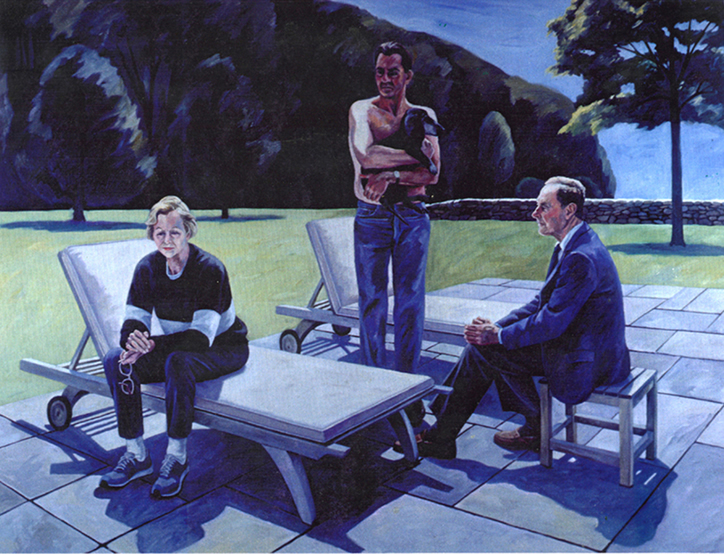
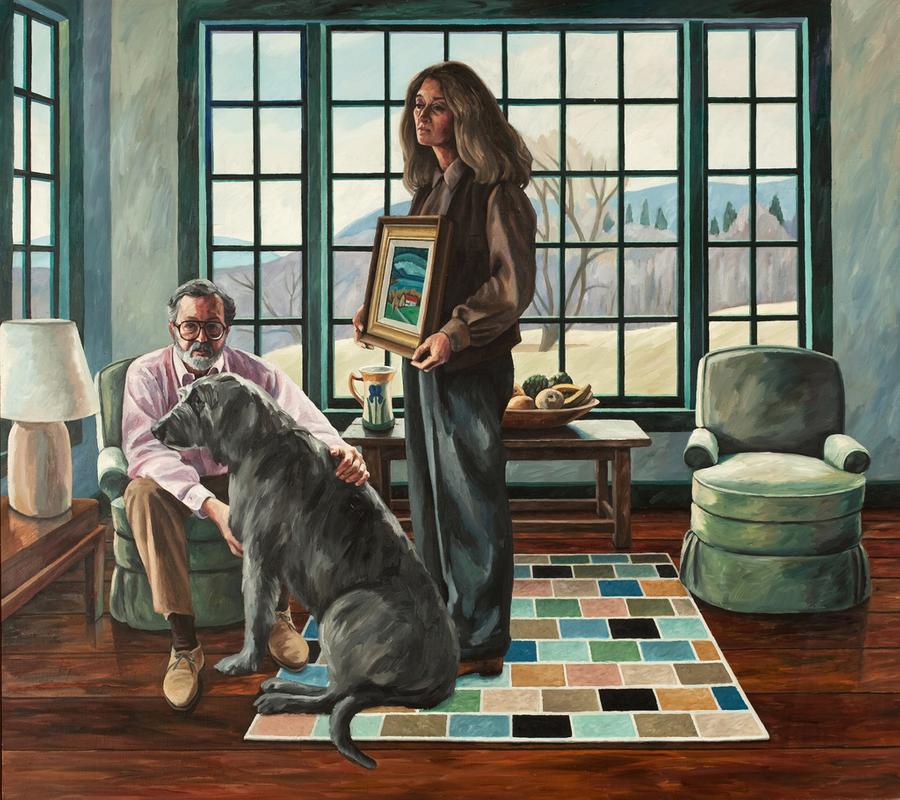
Norman Sunshine, The Messenger, 1995, and Possessions, 1996. USA.
Between 1995 and 1997, Norman Sunshine paints quiet moments shared by visitors to his home in Litchfield County, Connecticut. These are not typical sit-and-paint portraits; they are compositions that reveal the subtle interactions, attitudes, and sensibilities inherent in moments layered with meaning. The subjects appear deep in thought, or perhaps numb, as they meditate on something or nothing at all. The same is true for the two dogs featured in the paintings above. In The Messenger we witness a moment after some news was shared, presumably by the man in a suit. Another man, bare-chested, embraces his dog while looking upon the back of a woman seated before him, whose face we alone can see. They are not happy. Yet in the midst of this charged moment, the bond between a human and his dog is palpable. It is the kind of embrace that keeps us in check, and helps us ‘hold it together.’ In the trials, tribulations, and traumas of life, we comfort and are comforted by the animals in our lives.
In Possessions, a huge Russian Wolfhound is gently held by a middle-aged man whose hair and beard match his dog’s. The painting challenges notions of what or who a possession is. Once again, a man holds a dog, and a woman, forlorn, appears to look inward. She holds a painting of a house in the countryside, as she stands inside such a house. The man looks at us – we are there. A sense of nostalgia hangs over her painting; indeed, we carry memories that carry us through our lives. What happens when such memories are disrupted? Who can we turn to? Find The Messenger and other paintings on Sunshine’s Website. Possessions is featured in Sunshine’s book, The Book Of Norman: Norman Sunshine / A Life In Art.
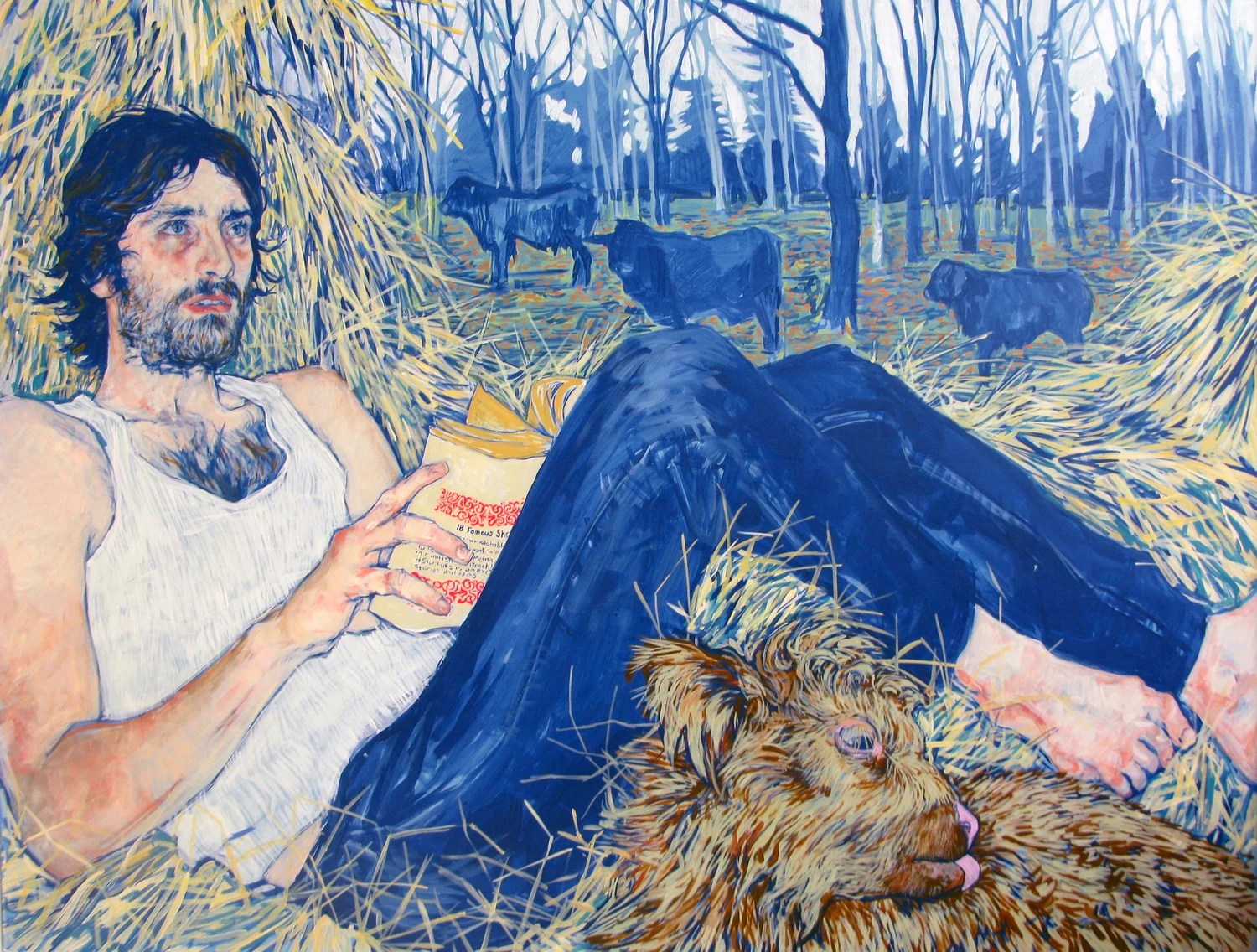
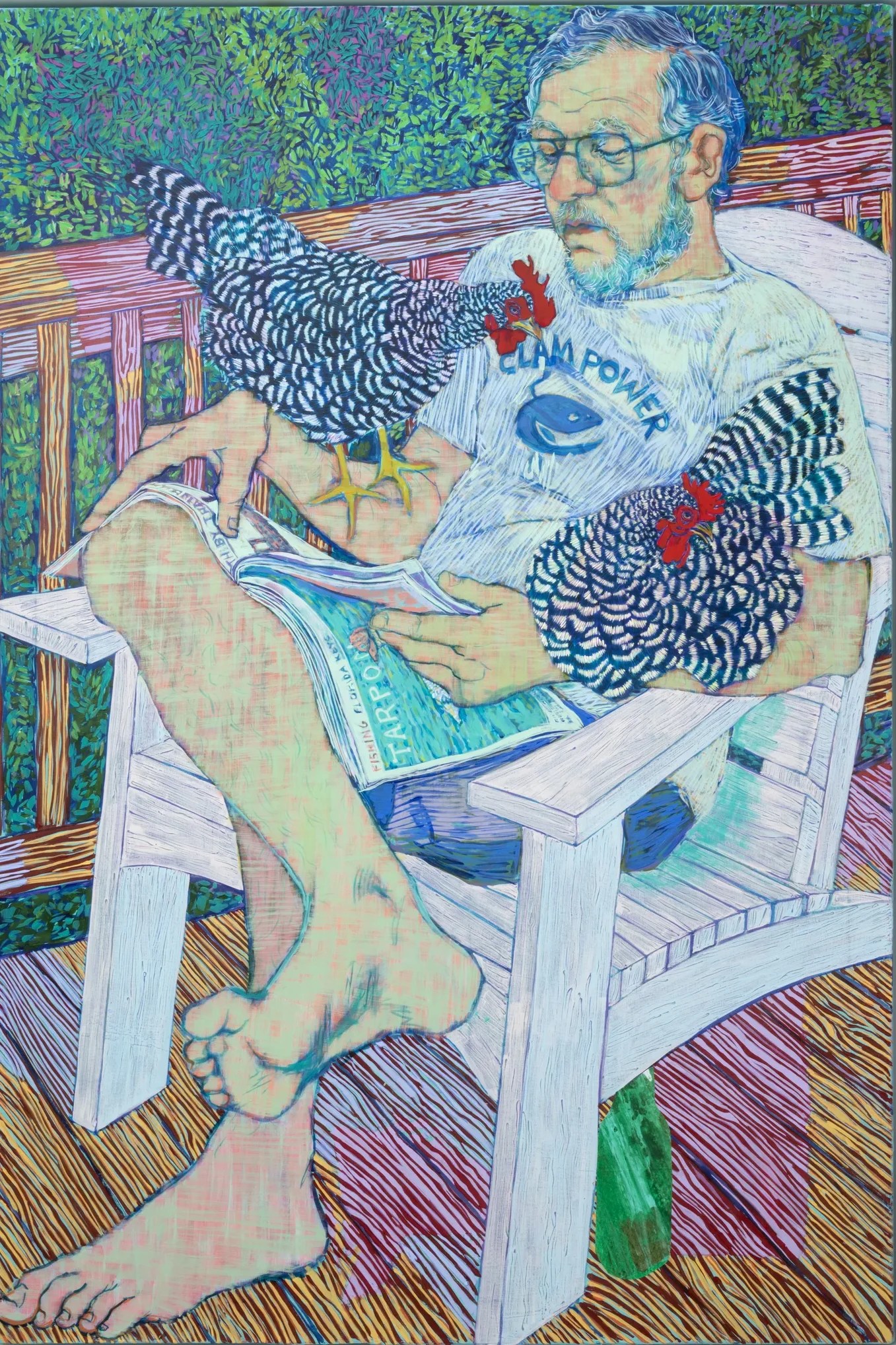
Hope Gangloff, Beauty and the Beast, 2009, and Moolog, Dad and Kieve, 2015. USA.
I was especially drawn to the way these two paintings by Hope Gangloff depict humans living comfortably and intimately among animals not conventionally regarded as “pets” (a calf and a chicken), while also engaging in the distinctly human activity of reading. These paintings suggest a world in which conventional boundaries between human and nonhuman animal life are softened, and through her use of color and line she envisions worlds resting lightly upon one another.
Gangloff’s work was recently exhibited in “Forces of Nature: Voices That Shaped Environmentalism” (2023) at the National Portrait Gallery, Washington D.C. and in “Women Painting Women” at the Fort Worth Modern (2022). Her work can be found in the permanent collections of the Grinnell College Museum of Art, Grinnell; National Portrait Gallery, Washington, D.C.; the Broad Art Museum, East Lansing; the Kemper Museum, Kansas City; and Pennsylvania Academy of the Fine Arts, Philadelphia, among others. Visit her website at https://hope-gangloff.com/.
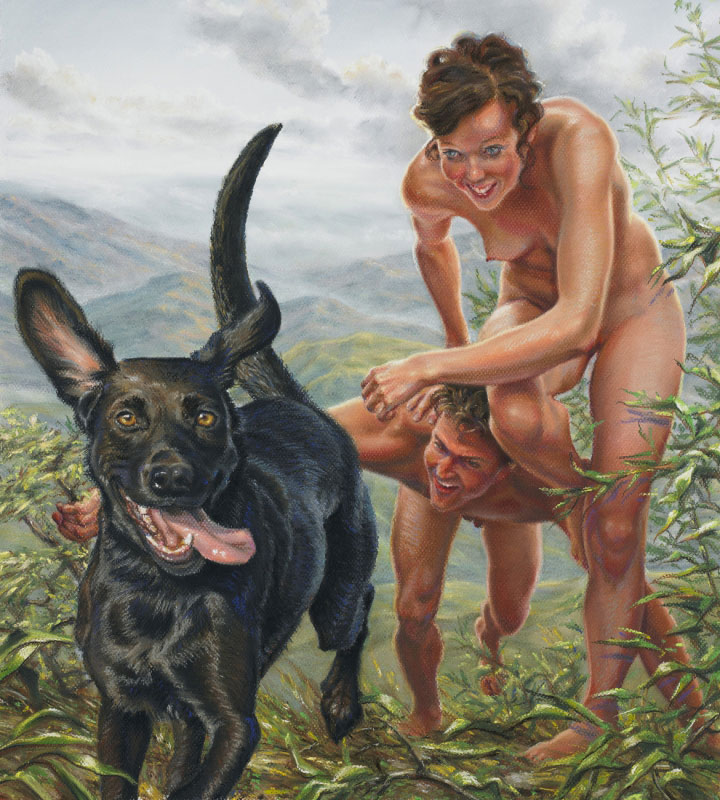
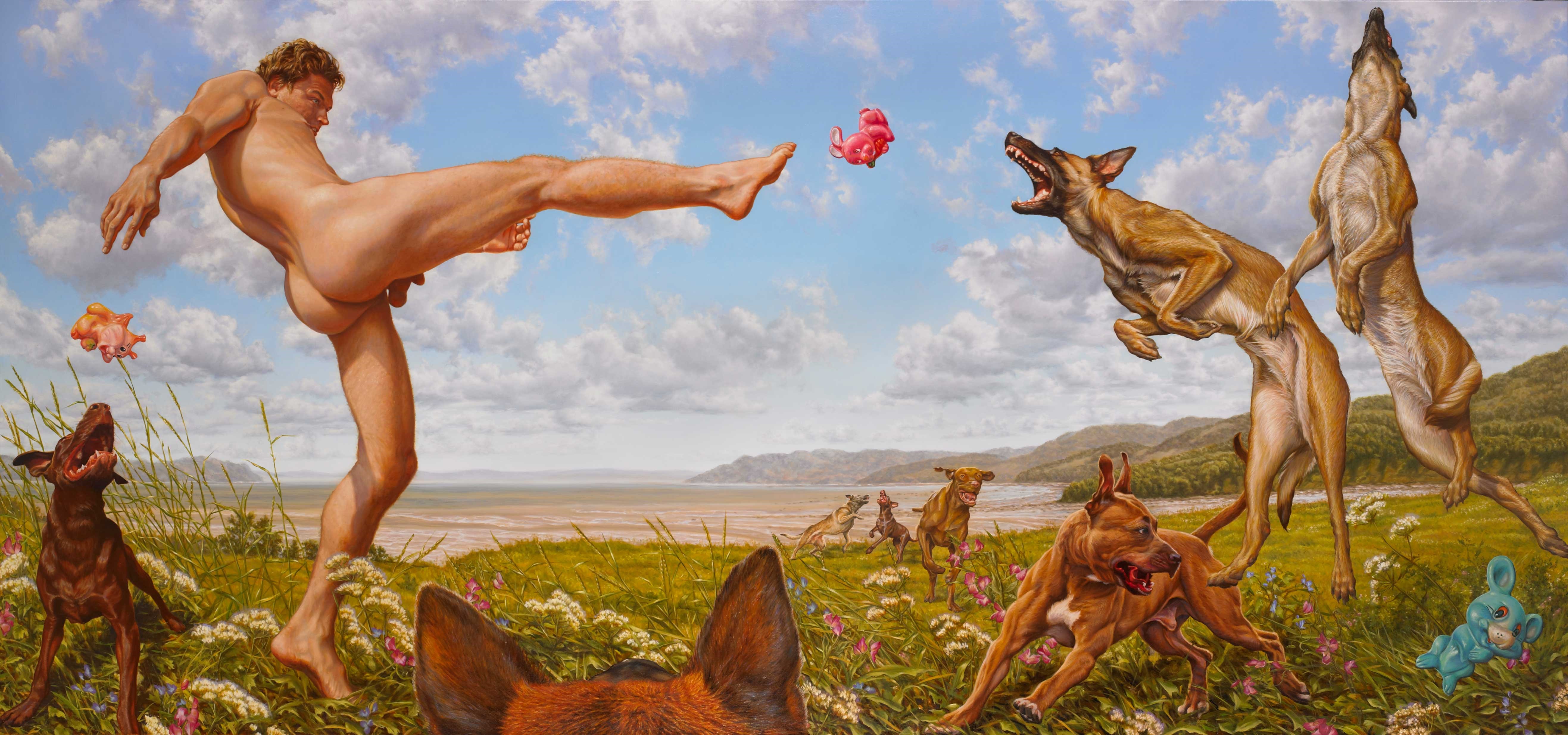
Susannah Martin, My Black Dog, 2014, and The Day I Quit, 2014. USA, Germany.
Look at this dog! Happy, free, and looking right at us! The dog in My Black Dog, at home in Nature, leads. A young white woman and man tumble about, laughingly, trying to keep up. Naked and natural, time and culture are irrelevant and gender is of little importance in their shared exuberance. In The Day I Quit, a young man plays with dogs, eliciting a yearning for our own free-spirited animality where dogs are peers, playmates, family, and opportunities for self-discovery and expression. The pink and blue floating toys, the same color as flowers in the landscape, signal a virtual world with new possibilities for connecting with nature.
Artist Statement:
“Something lives from longing in every human heart, return to its origin, after all alienation from God and from himself to find our way back to our eternal home.” – Felix Castles
“No representation of the nude in landscape in the 21st century can escape conveying our extreme estrangement from nature, intentional or not…yet it is indisputable, [people] gain strength, clarity and beauty when we contemplate [them] abstractly, as a phenomenon of nature…[With] the rise of the virtual world…we accept that realism now includes virtual realism, that is, it incorporates a high degree of improbability, a hyperbolic realism.” “To cope with the ever increasing virtual reality…they bring their dogs with them, the best friends of humans and their only remaining connection to nature.” Visit Martin’s Website.
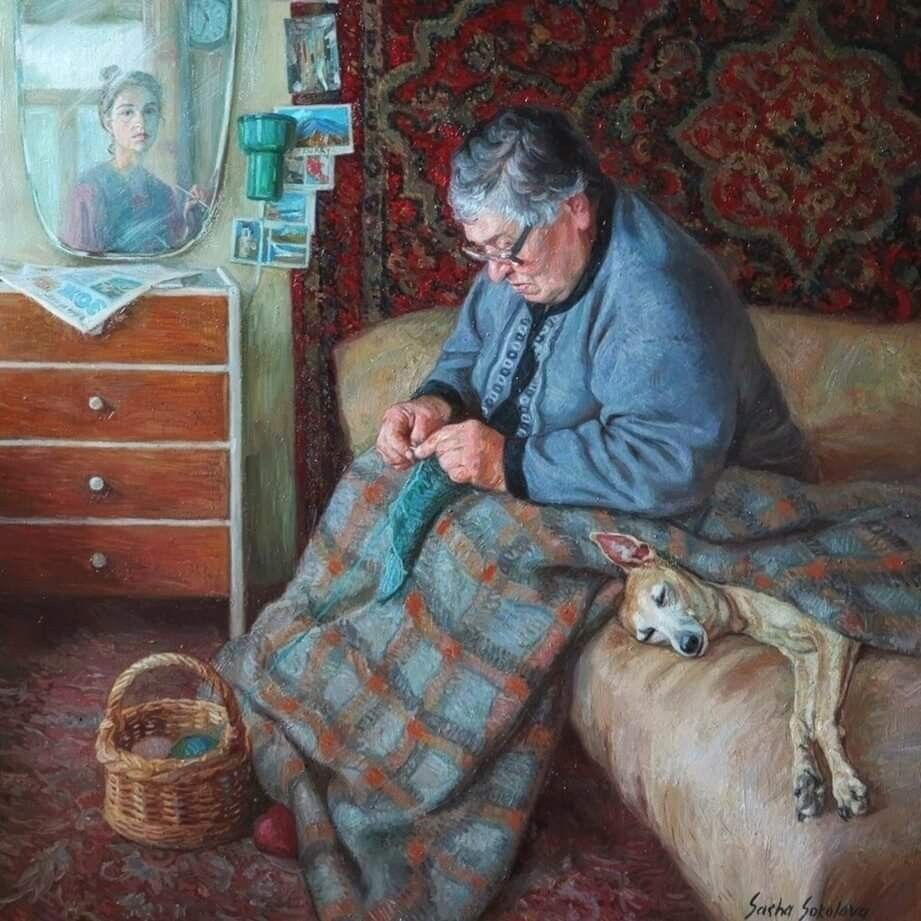
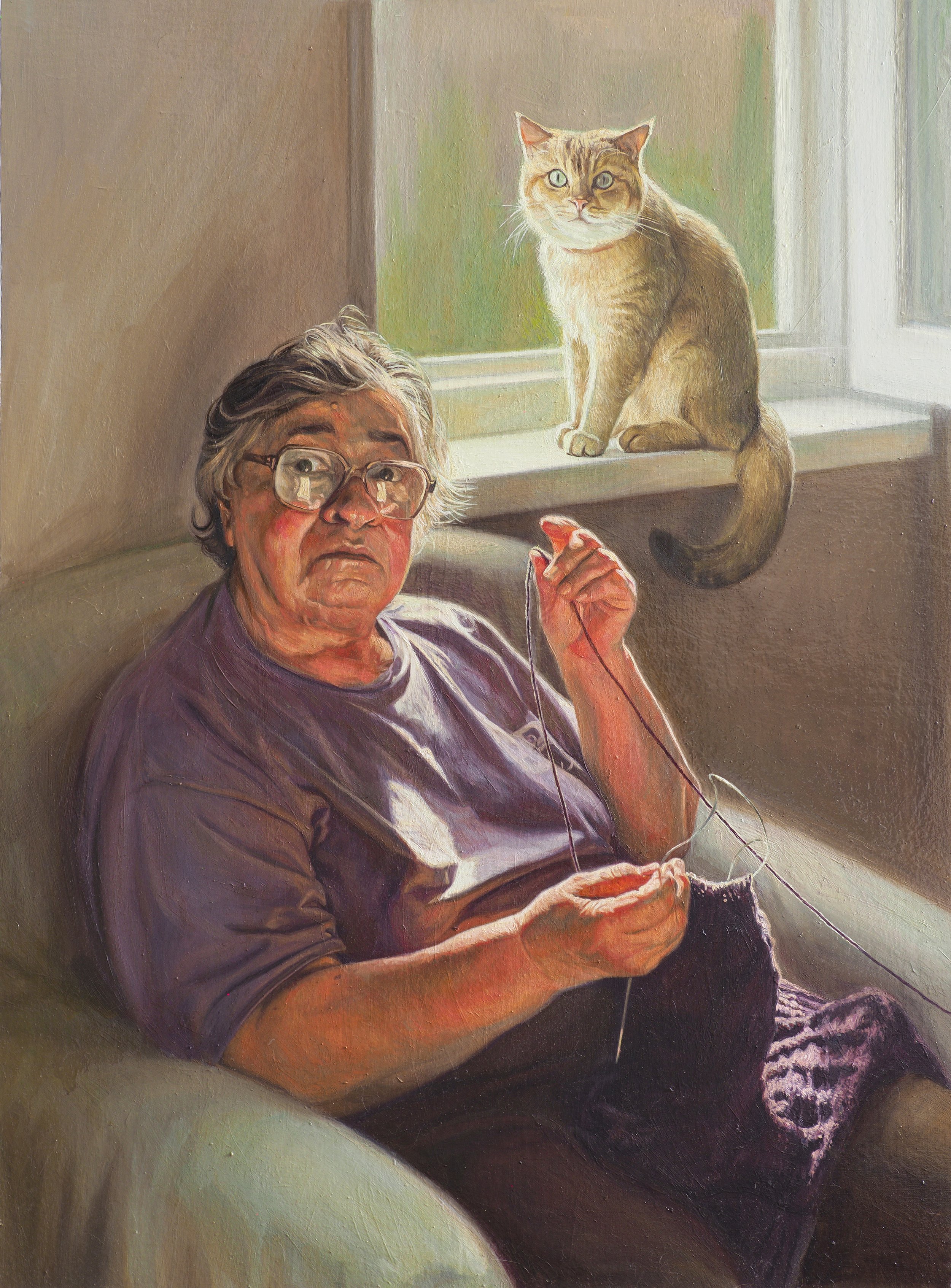
Sasha Sokolova, Self-portrait with Grandma, 2014, and Unexpected Visit, 2020. Russia.
Upon seeing Self-portrait with Grandma, I wrote to Sokolova requesting permission to include an image of it in our gallery. When I was a child, my mother had a great fear of animals. She overcame that fear after becoming a grandma herself. Once, in those latter years, she came to visit me in my new home in California. I found her sitting on the edge of the bed, quilting, with my dog, Max, lying beside her – a sight that would have been unimaginable years before. Sokolova’s painting depicts a similar scene of her Grandma together with her dog, sharing the same sense of nonchalance and mutual comfort, while the artist, reflected in the mirror, looks on. In Unexpected Visit, Grandma and cat regard us with the same expression – we are the visitor. See Sokolova’s current work on her website.
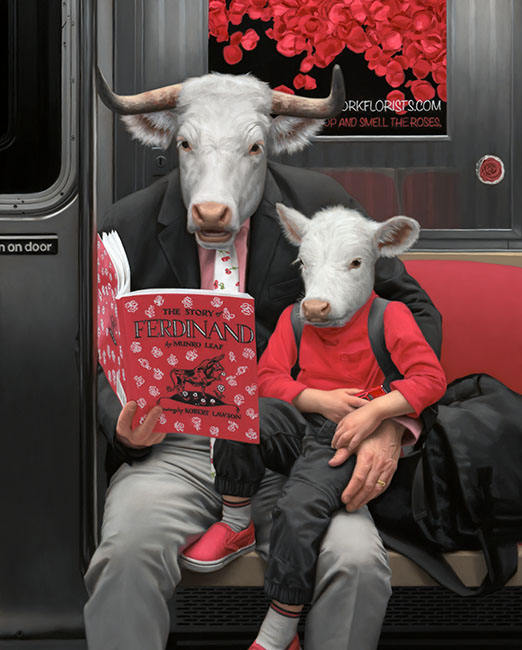
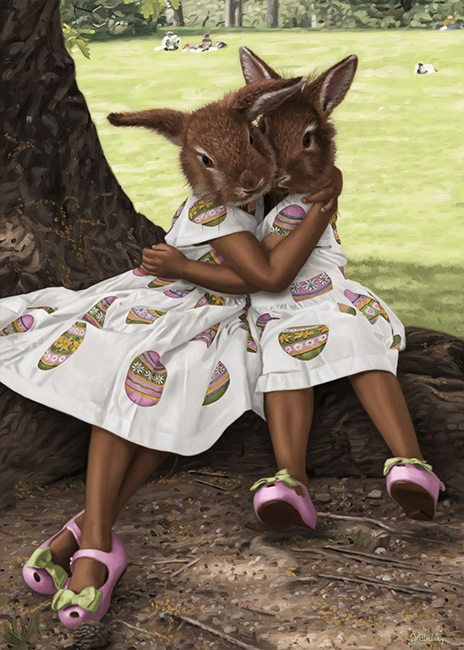
Matthew Grabelsky, 66th Street, 2016, and Cadbury Bunnies, 2020. USA.
Matthew Grabelsky is known for painting people with the heads of other animals, in New York City’s subway system. Inspired by hybrid beasts in folklore and myth throughout the world, he chooses an animal for each individual he paints to reveal something about their personality or character. In so doing, he reinterprets ancient iconography through contemporary people and places: these hybrid creatures are not apart from us, but embodiments of qualities we recognize in ourselves or others, encountered in the most mundane settings – even a subway.
As interviewer Michael Faith describes Grabelsky’s subjects, we see “their subconscious on full display.” Although Grabelsky engages popular stereotypes of animals (as depicted in mythologies), he also challenges them by showing these characters in relatable moments of everyday life. The animal faces, expressions, and postures are not drawn from iconic stories; rather, they express simple moments in living. Still, the animal veneer reveals that there is still much more beneath the surface. As such, Grabelsky brilliantly connects us to the entire animal world, even in the subterranean setting of a subway.
Read about The Story of Ferdinand on The Marginalian.
Artist statement on Cadburry Bunnies: “This oil painting was a surprise gift for my amazing friend @natasha_das_art. It was inspired by her daughters. A few years ago Natasha posted a photo of them in matching white dresses hugging on the couch in their apartment. As a joke I texted her a quick sketch of them with bunny heads in that pose. Later on when I was thinking about new settings for my animal characters I realized that they would be perfect sitting like that under a tree in Central Park. It’s their favorite place and they spend hours every day there exploring, observing animals, and learning about nature.” Visit Grabelsky’s Website.
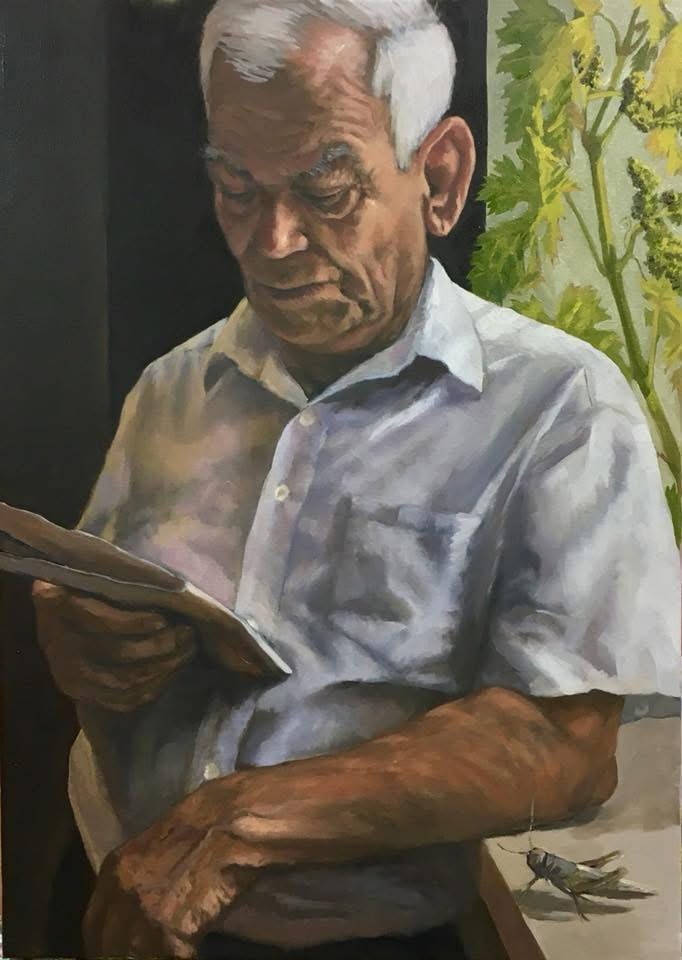
Gaetano Tommasi, Lettera al padre (Letter to my Father), 2018, and La grande armonia 1 (The Great Harmony 1), 2019. Italy.
Gaetano Tommasi (b. 1973, Lizzano, Puglia) is an Italian painter whose figurative works explore memory, intimacy, and the symbolic resonance of everyday life. After completing studies in Biological Sciences and Communication, he trained in Visual Arts at IED in Como. His paintings, often infused with autobiographical echoes, have been presented in solo and group exhibitions across Italy, including Florence, Rome, Modena, and Venice. Follow him on Instagram.
Artist Statement:
In Lettera al padre (Letter to my Father), my father reads an imaginary letter from me. At his side, almost unnoticed, a cricket appears — a discreet alter ego, my hidden voice taking shape in the fragile body of an insect. If the letter represents the invisible dialogue between father and son, the cricket becomes its incarnation: a mediator between silence and word, between absence and presence.
In La grande armonia 1 (The Great Harmony), my parents are depicted resting during a summer siesta. The scene truly took place in Puglia, in the province of Taranto, in Lizzano, the town where I was born. The perspective is mine — like that of a child, standing at the threshold of the room, gazing at his parents immersed in a shared sleep. Around them, the silent presence of a dog and a cat becomes essential: not mere domestic companions, but discreet guardians of a familial harmony that extends to all living beings. The room itself seems to breathe in unity, as if humans and animals were part of the same suspended time.
Together, the two paintings reflect a world where animals are not ornamental, but bridges of meaning: they complete the human scene, opening it to a larger harmony that unites memory, affection, and the flow of generations.
Support the Galleries
Your generous donation helps us expand our collections and create a more interactive experience within our galleries. Support our mission.
Historical Survey • Global Perspectives • Contemporary Gallery
❖ Sister Exhibition: Animals, Nature, and Grief (Green Pet-Burial Society)
Originally published: 2/25/2023 · Updated: 9/26/2026


I was finally able to open the website
So beautifully done, just loved it
LikeLiked by 1 person
So pleased to hear this! Hope you had a chance to look at our other galleries as well, including our Pre-WWII Gallery, and our Sibling Art Gallery.
LikeLike